Australia Weather News
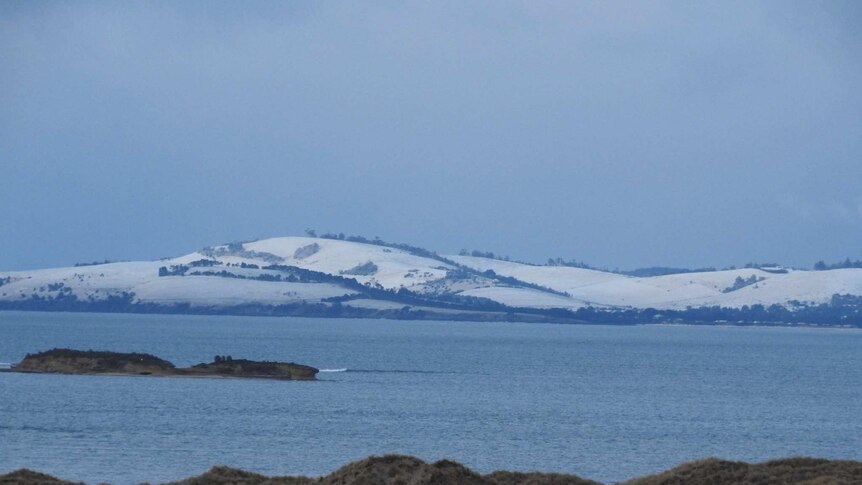
The view from Lewisham of a snow-covered Clifton Beach and surrounds in 2015. (Supplied: Christine Gaby)
July 25, 1986, was a day Hobartians awoke to find, quite literally, that their streets had turned into a winter-sports wonderland overnight.
Bernadette recalls being drawn to her window because of the "silence".
"Because I'm used to the hum of the traffic, and it was so silent," she told 936 ABC Hobart this week.
"I went and looked out the window, and while I was standing there, a guy went down past my house on skis," she said.
"Hey, somebody's just skied down the Southern Outlet!" she yelled to her family.
"And one of my kids goes: 'Mum, don't you think it's a bit early to be drinking in the morning?'"
The 1986 event was the heaviest snowfall in Hobart in 65 years, with 8 centimetres blanketing the city, only 4cm off the city's biggest snowfall on record.
There was talk of then-premier Robin Gray eating his words, after he brushed off criticisms of being a dictator by saying if he was, "there'd be snow on the steps of Hobart's post office".
But residents also remember the ensuing mayhem, with only 20 per cent of employees showing up to work.
On the Midland Highway, which connects the north to the south of the state, 29 semi-trailers jack-knifed as drivers attempted their normal commutes.
"It was hopeless trying to work because everyone was either not there or taking advantage of it. You couldn't get anything done," Mike told 936 ABC Hobart.
Malcolm, who was employed at the zinc works at the time, said the company, "to their great credit, paid everybody for the full day if they got there by lunchtime".
Emergency services vehicles struggled in the conditions which they were not equipped to handle.
"It was very difficult for emergency services because most of the police cars were two-wheel drive, so they were actually putting out calls to borrow four-wheel drives from car outlets that sold them," Ian, then a park ranger, said.
One father said he won't live down the fact he tried to send his kids off to school, while other parents presumed school was cancelled.
"The children, well they're adults now, do not let me forget that I made them go to school, and they were the only ones at the school, and the poor little fellas had to walk home again," Rod said.
Hobart resident Grant said his sister rarely had birthday parties throughout the 70s.
"My sister's birthday is in August, and we used to get snowed in virtually every year. And I remember she couldn't have a birthday party for three, four years in a row because we were snowed in," Grant said.
"But nothing happens like that anymore, and it's quite sad really, because the weather's certainly changing," he said.
On an August day in 2015, snow did fall to sea level in some parts of southern Tasmania.
That day, then-17-year-old Tabbi Fasnacht and her father Pat crossed snow instead of sand for their morning surf at Clifton Beach.
According to the Bureau of Meteorology, extreme low-level snow events are becoming less and less likely.
So far, the winter of 2026 has made the top five warmest June-July periods on record, the BOM said.
"There is a long-term trend for a decrease in the number of 'low snow' events in Tasmania," it said in a statement.
"There is very high confidence that as warming progresses, there will be very substantial decreases in snowfall, increase in melt and thus reduced snow cover."
The BOM said while snow is not completely off the radar, the air is just too dry lately, with rainfall being about 20 per cent below average across Tasmania.
"In more recent years, there have been many events where snow to 300 metres has been possible, but more often than not, there is little moisture in the atmosphere at the same time.
"Moisture coincident with the cold air is required to have snow instead of just a cold day," the BOM said.
So for now, those days where Tasmanians wake up to a mountain top iced like a Boston bun, that might be as close as low-level city dwellers get to snow.
ABC