Australia Weather News
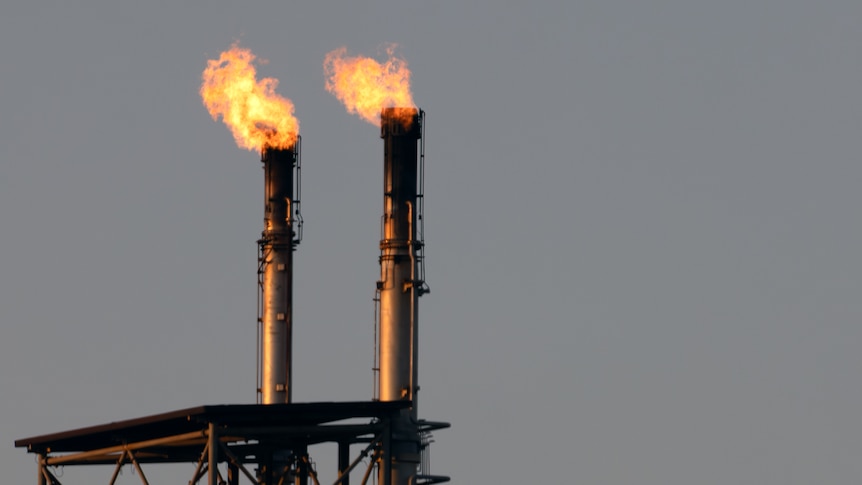
Gas has long been the traditional peaking fuel in Australia, but times are changing. (ABC News: Chris Lewis)
Runaway demand for turbines from data centres in the US is making new gas-fired power uncompetitive with batteries in the evening peak for the first time, a report has found.
Australia's top science agency, the CSIRO, said batteries were helping to lower high evening prices for electricity as the costs of the technology fell and significant extra capacity was added.
At the same time, the CSIRO said the costs of gas-fired power were rising as insatiable demand for power from data centres caused a shortage of the giant turbines at the heart of gas plants.
[Costs chart]Data centres are enormous farms of servers that are being used to power the boom in artificial intelligence.
While the centres are springing up all over the world, in no country has their arrival been as pronounced as the US, where the Department of Energy forecasts they will consume 6.7 to 12 per cent of electricity by 2028.
Paul Graham, the agency's chief energy economist, said the extraordinary growth of data centres, and their consequent need for gas-fired power, was flowing all the way through to Australia.
Mr Graham leads the CSIRO's GenCost project, a collaboration with the Australian Energy Market Operator that assesses the cost of building new generation and storage technologies.
"As battery costs continue to fall and gas technology costs rise, batteries are increasingly becoming the preferred flexible generation technology in the near term," Mr Graham said.
"However, GenCost modelling finds gas technologies will still play a limited but important role in helping firm the electricity system, contributing around 3 to 7 per cent of generation by 2050."
'If data centres were a country…'
The findings from the CSIRO follow a major report from the International Energy Agency last year which noted data centres were up-ending the planning for grids worldwide.
Global energy consultancy Lazard, meanwhile, issued similar findings yesterday, saying demand from data mining was pushing up power prices for all technologies.
In its report, titled Energy and AI, the IEA, a club of mostly rich nations, said data centres had been driving up the cost of turbines for years.
"If data centres were a country," the agency noted, "they would be the second-largest destination for gas turbines ordered" in the 12 months to the first quarter of 2026.
"Data centre electricity consumption is set to more than double to around 945 [terawatt hours] by 2030," the IEA wrote in its report.
"This is slightly more than Japan's total electricity consumption today."
The CSIRO said turbine costs would continue to rise before stabilising later this decade.
By that stage, the agency said, renewable energy sources such as wind and solar would be meeting an ever-greater share of Australia's electricity demand.
The organisation said while some conventional technologies such as black coal plants could be broadly competitive if carbon costs were excluded, it argued they were "not suitable for deployment".
Among the reasons, the CSIRO said, were political objectives to achieve "net zero" by 2050.
More pointedly, however, the agency said there were no serious proposals to develop any coal plants in Australia by the end of the decade.
"Solar PV and onshore wind are almost exclusively the only generation technologies sufficiently advanced in the development pipeline to be deployed before 2030," it said in the report.
"Their deployment is being supported by existing flexible gas and coal together with new battery, pumped hydro and transmission capacity."
Long-term outlook is renewable: CSIRO
According to the CSIRO, average prices in the national electricity market spanning the country's eastern seaboard had fallen from historic highs of $189 a megawatt hour in 2022 to $104 a megawatt hour in 2025.
It said generation costs could fall further still "to between $80 and $90/MWh by 2030" as more generation and storage capacity was added to the grid.
Average wholesale spot prices in the national market, according to AEMO data, were typically much lower before 2017, when there was more relatively low-cost coal and cheaper gas.
In any case, the CSIRO noted generation costs typically made up about a third of the retail costs paid by consumers for electricity.
High-voltage transmission lines accounted for about seven per cent of bills, low-voltage distribution lines made up 34 per cent, while the rest comprised metering, retail and government costs.
Longer-term, the agency said solar and wind power would by 2050 supply as much as 93 per cent of Australia's electricity needs.
The remainder, it said, would come from a mix of hydropower, storage, transmission between states and "either gas or hydrogen or a combination of both".
[Price spread]Solar thermal plants, which differ from photovoltaic solar panels, could be competitive, the CSIRO said, but they would be hampered by a need to be built further from cities to tap better solar resources.
Mr Graham said the energy market might be a goliath, but it was also dynamic and subject to change.
"Each year GenCost, with the help of stakeholders, seeks to understand how electricity technology markets are changing," Mr Graham said.
"The impacts of the Iran war and data centre demand for gas turbines are currently the strongest drivers of uncertainty."
ABC