Australia Weather News
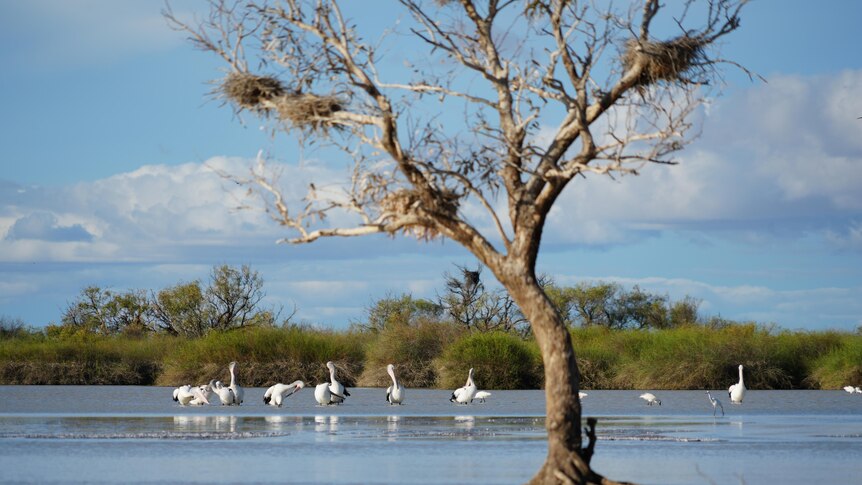
Cuttaburra Crossing is a popular bird breeding meeting spot. (ABC Western Qld: Hannah Walsh)
After the rain, come the birds.
From pelicans to herons, winged explorers of all colours, shapes and sizes have flocked to the desert's edge on the promise of bustling wetlands.
It's an age-old story for the often-dry inland river systems of one of Australia's biggest breeding basins — the Channel Country.
Significant rainfall this year means locals are making rare sightings of birds, such as the golden-headed cisticola.
Bush Heritage ecologist Helene Aubault said it was "very unusual" to see the cisticola so far inland, captured in photos by volunteers, but said the insects and water had attracted the bird to the desert's edge.
Dr Aubault said the Simpson Desert and nearby channels were not usually suitable habitat for the golden bird.
But that changed after more than half a metre of rain, or two-and-a-half times the area's annual average rainfall, fell since January.
"It's often only one or two birds that are bit more adventurous than their other friends and have come to take a look," she said.
An 'unbelievable' season
In addition to birds, the "boom and bust" cycle of the Channel Country has also led to a sharp rise in small mammals, lizards and insects.
Anne Britton, a photographer and birdwatcher, has lived near Boulia for four decades and said this year's wet season had attracted "hundreds and hundreds" of birds.
"We do get the pelicans even when it's dry, [but] the new ones we've had in the past couple of years are massive flocks of ibis [and] massive flocks of hawks," she said.
Ms Britton said this year's rainfall had been "unbelievable" with 365 millimetres so far, an "absolutely amazing" outcome for the region's agriculture and tourism industries.
University of Southern Queensland's Jarrod Kath, who researches migration patterns, said waterbirds arrived inland from along the east coast and Western Australia.
Dr Kath said rain was the trigger for many of the birds making the thousand-kilometre journey inland, but he said it was still a mystery how they knew where to go.
"When there's good events, these birds somehow know that something is going on and they'll get up and take flight and head to some of these arid regions," he said.
"They may have a good memory — when this is drying out, they [know] the wetland down the road about a thousand kilometres is in good shape, so I'll have a sticky-beak there."
He said researchers were also considering whether birds could "hear storms" or "smell productive flood plains".
Bird flu a 'potential' concern
While this year's season is exciting for birdwatchers, Dr Kath said there was a slight chance the dense number of birds could contribute to a further spread of H5 bird flu.
The area is also a common pit stop for migratory birds arriving from overseas, increasing the risk of the deadly strain being carried in by either coastal or foreign species.
"You might get a large congregation of birds in high numbers and then if [the virus] is spread there, they may disperse in unpredictable and highly variable ways across the country," Dr Kath said.
However, experts believe the chances are slim.
University of Queensland avian ecologist Elize Ng said the virus could only spread inland if there was transmission between oceanic and coastal birds, which has not yet happened.
"Currently the disease is being transmitted by sea birds, which usually should not be in the middle of the country," Dr Ng said.
"[Those sea birds] get washed up on the coast and if [bird flu] makes it inland, it'll be through birds on the coast interacting with these dead carcasses."
Dr Ng said the risk would be higher in Australia's summer, when migratory shorebirds arrive from the north.
ABC