Australia Weather News
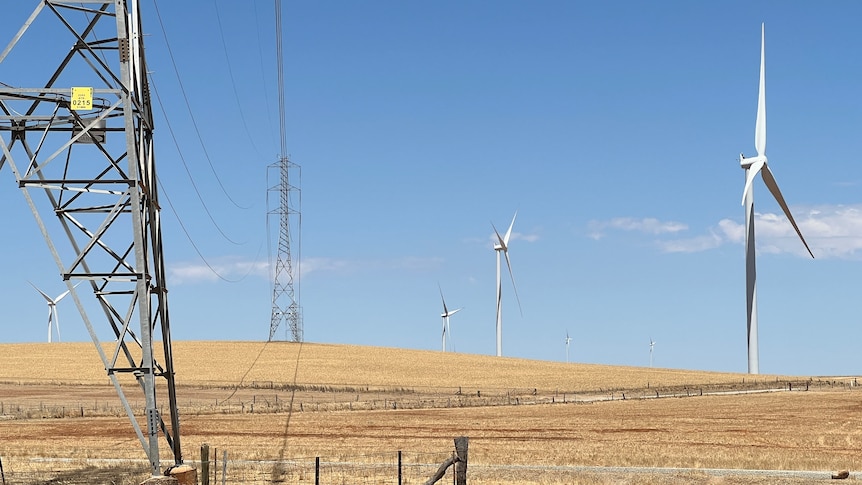
Australia's renewable energy industry is experiencing growing pains. (ABC News: Daniel Mercer)
Spot electricity prices that soared to their maximum allowable level.
Emptied batteries unable to supply a grid desperate for more energy.
Dormant gas plants that fired to life and ran flat-out for days to keep the lights on.
South Australia may be the country's renewable energy flag-bearer, but its embrace of the transition has been subjected to one of its sternest tests yet.
For four days on the trot, a state that gets the greatest share of its electricity from wind had practically no wind at all.
"Events like this are a reminder that the challenge is no longer simply building renewable generation," wrote Gavin Mooney, a former Australia manager for energy software firm Kaluza.
"The harder task is ensuring there is enough flexibility in the system to manage the relatively rare periods when wind and solar output falls across a large geographic area."
Indeed, the events in South Australia over the past week or so highlight the extremes that can characterise an electricity system running largely on renewable energy.
One extreme to another
South Australia was producing so much wind power on the evening of Thursday, June 18, that it was able to meet all of its needs and export surplus production.
But just a few days later, overnight on Sunday, the state was almost totally becalmed.
Wind accounted for just 1 per cent of South Australia's electricity needs.
Virtually all of the rest was coming from gas-fired generation.
[Fuel mix]And what couldn't be provided by gas was imported from Victoria, where equally calm conditions meant that state's power was being generated mostly from coal.
Paul McArdle is an electricity market expert who runs specialist firm Global-ROAM.
While seasonal lows in renewable energy output in winter were a known phenomenon, he noted the "wind lull" that affected South Australia last week was highly unusual.
He said the state had installed wind capacity of almost 2,800 megawatts — equivalent to three large coal-fired plants.
But in the four days to Wednesday, McArdle said the "rolling average" generation from those wind farms was just 124 megawatts, or an availability of 4.5 per cent.
By comparison, he said wind output compared with capacity had been 5.6 per cent and 6.6 per cent during the previous two worst recorded lulls.
"So, from this data, it seems safe to conclude that the recent wind lull in South Australia was the worst experienced [at least] since 2019," McArdle wrote.
[Wind output]The pain of prices
A major corollary of this lull was a dramatic spike in spot electricity prices.
According to data from the Australian Energy Market Operator, wholesale prices hit the legal ceiling of $20,300 a megawatt hour twice during the episode.
Average wholesale prices in South Australia were $88 a megawatt hour in the first three months of the year.
[Price spikes]The first was on Monday evening after the sun had set and as the wind stayed still.
Crucially, batteries appeared unable to stop wholesale prices getting out of hand.
In a post, Australian firm OptiGrid said battery owners "discharged heavily through the afternoon and early evening, chasing the gradual rise in prices".
While many batteries were running low as the price climbed higher, "around half managed to catch the first extreme price interval".
Crucially, however, almost none were able to capitalise the second time prices spiked to $20,300 a megawatt hour the next morning.
Some batteries were even charging as prices soared, paying up to $10,000 a megawatt hour to store electricity that was overwhelmingly coming from gas generators.
"Despite another period of $20k prices, relatively little battery capacity was able to respond," OptiGrid noted in its post.
"Holding charge for a spike that may never arrive is an uncomfortable decision, right up until it turns out to be the only one that mattered."
Making matters worse, constraints to the high-voltage transmission network meant South Australia was exporting electricity to Victoria even as its prices rocketed.
[export chart]Jess Hunt, an electricity market designer, wrote that such "counter-price flows" were not helpful.
"This seems to have been happening a lot lately, but the outcome [on Monday] was particularly painful," Hunt posted.
"By 8pm our batteries were drained and we hit the market price cap."
'Stress testing' a grid
Geoff Eldridge, an electrical engineer who runs consultancy Global Power Energy, said the prolonged lack of wind in South Australia was a "stress test" for its electricity system.
Eldridge said a single day of low wind and solar output could create volatility, but a four-day lull could examine the resilience of the grid.
"Batteries, gas, imports, interconnector capability and demand response all become more relevant," Eldridge wrote.
Eldridge said the past week was hardly a repudiation of South Australia's transition.
He noted that on a long-run basis, South Australia was on average getting more and more of its power from wind.
From barely 40 per cent six years ago, its share had increased to about 50 per cent on a rolling one-year basis.
"A good trend can still contain a difficult test," he said.
"South Australia's wind transition looks strong on the long view. But the short view says something different.
"That does not cancel the long-run trend. It tells us where the system is being examined."
Eldridge said the South Australian experience showed the flip side of a system that ran largely on renewable energy sources that were at the whims of the weather.
Key among them are the rapid ways an excess of wind and solar power can become a scarcity, the central role of gas in backing them up and the limits of batteries as a tool to manage the grid.
"This is where the transition debate often becomes too binary," he wrote.
"Batteries can be valuable and still not be the whole answer to a multi-day winter lull.
"Gas can be essential in the event and still raise questions about emissions, fuel risk and long-term role.
"Interconnection can help, but only if neighbouring regions have spare flexibility when it is needed."
At the bleeding edge
It was a point echoed by Gavin Mooney.
He said South Australia was a world leader in its adoption of renewable energy and its shift away from fossil fuels.
As such, he said the state provided invaluable lessons for other jurisdictions about the risks and opportunities of the transition.
And a key one of those, he said, was flexibility to deal with the vagaries of the weather.
"That flexibility can come from many sources, such as storage, transmission, demand response and dispatchable generation," Mooney wrote.
"And as renewable penetrations rise, the value of that flexibility becomes increasingly apparent."
South Australia Energy Minister Tom Koutsantonis did not resile from the challenges posed by abnormal weather conditions, however infrequently they happened.
Koutsantonis said the South Australian government was aiming to develop "significant volumes of long duration" storage that could be called at will.
He said the amount of large-scale battery capacity in the state would more than double to 2.5 gigawatts, or 2,500 megawatts, which would be able to power about 300,000 homes for eight hours.
The minister noted that even though wind output had been minimal this week, "solar generation has remained solid".
"This week's weather is precisely the type of situation we are planning for," Koutsantonis said.
"As one of the world's leading jurisdictions in integrating a high proportion of variable renewable energy into energy systems, South Australia has been among the first to address the challenges that come with it.
"The higher prices associated with gas providing these short-term services will also be subject to downward pressure as our comprehensive strategy for bringing more gas into our state takes shape."
ABC