Australia Weather News
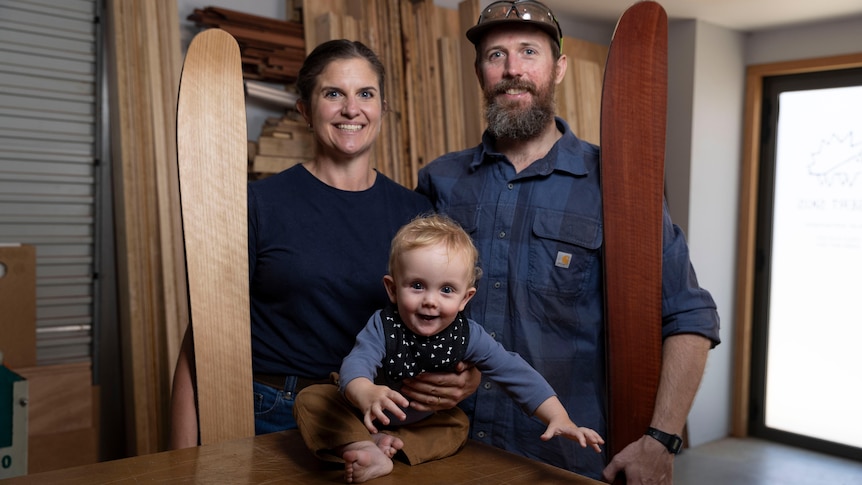
Steph and Jonathan Paige make skis in a workshop in Jindabyne. (ABC Landline: Floss Adams)
Jonathan and Steph Paige didn't quite know what they were embarking upon when they decided to make handmade skis out of Australian-grown timber.
"You could probably get a job at a big company in Europe or the US and have somebody show you the ropes," Jonathan Paige said.
"Being here, it was very much just learn as you go, refine, reiterate."
It was in 2019, when the husband-and-wife ski enthusiasts were living in Western Australia — a place far removed from the Australian snow scene — that Jonathan "JP" decided to give ski making a go.
"The first couple of pairs we pressed were catastrophic. The first one was a total botched job," JP said.
But they were "so pumped", despite persisting through a trial-and-error process not for the faint-hearted.
"There are so many variables. Temperature, humidity of the timber, the day you're milling it, the day you're gluing it up, the type of timber you're using," he said.
Australian timber skis
Years on, the Paiges have fine-tuned their craft and now operate out of a workshop in Jindabyne in the NSW Snowy Mountains.
At the heart of the handmade skis is a wooden core made from a carefully considered combination of Australian-grown alpine ash, jarrah and paulownia.
The core's main timber is a "dense" alpine ash hardwood, a eucalypt native to south-eastern Australia that allows for flexibility in the ski.
"It does give a little weight to the ski," Steph said.
"You need that weight to improve the feel [of the ski], so when you're skiing through something that may not be perfect power or perfect grooming, you want your ski not to be chattering away."
This alpine ash is harvested by the NSW Forestry Corporation in the Riverina region, west of Canberra, and processed at a timber mill in Eden on the NSW far south coast.
As of March, the alpine ash forests of the Australian mainland have been declared as endangered by the federal government.
The request for the specific hardwood boards was far from the usual orders that pass across Damien Bunting's desk.
"This is a little bit more meticulous, and you've got to really search for the right quality boards," the general manager of South Coast Timber said.
"It is quite specific. They can't have any knots or any imperfections at all.
"It can get a little bit monotonous sometimes in the mill, so when you get an opportunity to do something that's a little bit out of the box, you're like, 'Let's get into it'".
The alpine ash is cut when conditions are right and air dried, before spending weeks in a 40-degree Celsius pre-dryer and a kiln.
This drying process can take about six months.
"When you're dealing with a natural product, you can't rush it, or maybe you can, but you're risking destroying it," Mr Bunting said.
"Take your time, you push it through nicely and the rewards are at the other end."
In JP and Steph's skis, the alpine ash is joined with the light balsa wood paulownia, and a thin piece of native jarrah holds the core together.
"[Jarrah] is really good at taking an impact because the grains are so tightly packed and it is naturally water and rot resistant," Steph said.
Jarrah is a hardwood native to Western Australia, which has become more challenging to access since the state government banned native forest logging in 2024.
The couple had previously accessed jarrah from a mill that was shutting down in Albany in WA and from a tree that had fallen during a storm on a family member's property.
The Paiges said they were now working with a mill in WA to source timber from other jarrah trees that had already fallen or were being cut down for construction projects, but they were mindful about what they're using.
"We're using small dimensions and so we're able to extend the use of a single board through that," JP said.
"The timber that we're using increases the life cycle of the ski itself, and so [it is] encouraging people to use the same ski for longer and not buy new pairs every year."
Labour of love
The wooden core is glued and dried, before it is laminated between a plastic base and a wood veneer top sheet, that is all held together by a steel edge.
It then takes weeks to cut, grind, polish and oil the skis before they are tuned, waxed and have their bindings mounted.
"Every step takes time and it all adds up, but everything takes the amount of time it needs. Nothing is fast here," JP said.
The plastic base and ski edge are imported products, but the rest of the materials in the skis are Australian made.
Living in a country more familiar with sun and surfing than snow-covered mountains makes the ski-making process all that more challenging, with high freight costs and a small local industry to rely on.
'Whilst we're deep in winter, it's summertime in the northern hemisphere. Most of your suppliers … we're just not on that same schedule," JP said.
The first winter
Desert Skis only opened to the public in winter 2025, after five years of trial and error and testing product samples.
"It was motivating because after five years, you are kind of like, 'This is a long journey. This is a lot of money. Is this going to be worth it?'" Steph said.
"There are times when you're kind of looking at each other like, 'What are we doing?'"
Local backcountry skier Rowan Kennedy, a friend of the Paiges, is among their growing base of customers.
"It brings joy, seeing the creation of the ski, knowing where the timber comes from, knowing it's locally sourced," Mr Kennedy said.
"You see the production from start to finish and you know that you're giving a job to a local person."
Steph said they want to keep the business manageable in the future, so that sustainability could remain at the fore.
"It's really important to us that they are handmade, that we respect the timbers that we're using, that we can source locally," she said.
"If we scaled too quickly, too fast, we wouldn't be able to control the quality and there would be more waste."
For JP, the goal has always remained simple: to connect back to their beloved snow community by making a local product that can be ridden in the alps.
"It might be four, five, six, seven, eight of us on our skis that we've made," he said.
"It's cool when you sit there and just take it in for a minute. You go, 'Man, this is rad'.
"Everything we're having fun on is from here. How cool is that?"
ABC