Australia Weather News
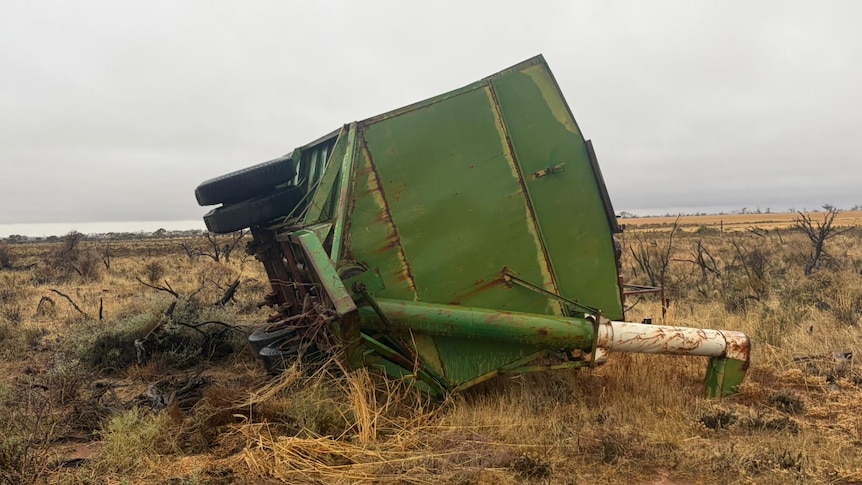
Leigh Strange says the storm left its mark on his property. (Supplied: Leigh Strange)
Farms and business across Western Australia's Wheatbelt have had roofs torn off buildings, heavy machinery moved, and trampolines go missing after they were hit by intense weather systems triggered by ex-Tropical Cyclone Mitchell.
Ex-Tropical Cyclone Mitchell began as a tropical low in WA's northern Kimberley region last week, before forming into a cyclone along the Pilbara coast over the weekend.
At Bruce Rock, 240 kilometres east of Perth, Leigh Strange described a powerful, localised weather system which swept across his property as "the most intense" he had seen.
"We've got house damage, with some of the verandah missing, workshop doors which have been blown off, a seed cleaner that has been thrown a fair way — I'd hate to think how many trees have been pushed over," Mr Strange said.
"I've never seen anything that strong, it was really intense, the rain was horizontal."
He said he had received nearly 92 millimetres of rain since Monday afternoon, and had repeatedly lost power.
"It was a bit nerve-racking for a minute or two," he said.
"I've spoken to people around me, there is another farmer who has lost three doors off his shed, a couple of silos have gone tumbling."
Dust storm crosses Lake Grace
Meanwhile, further south in Lake Grace, the roof of a pub was ripped off in what owner Shane Carruthers described as a "mini tornado" on Monday afternoon.
The Bureau of Meteorology said Lake Grace experienced wind gusts up to 91kph, while in nearby Newdegate, wind gusts reached 106kph.
Lake Grace resident Steve McPherson said a dust storm that crossed over the town was "unbelievable".
"I have lived in Lake Grace for 30 plus years, I have never seen anything like this," Mr McPherson said.
"It was so thick, the trees were going down, things were blowing everywhere, I think there is trampolines still yet to be located."
Ex-tropical cyclone wash up
The Bureau of Meteorology said the storms across the Central Wheatbelt and Goldfields were fuelled by lingering moisture from ex-Tropical Cyclone Mitchell.
By about 1am on Tuesday, ex-Tropical Cyclone Mitchell weakened to a tropical low before crossing the coast, east of Shark Bay, with authorities issuing flood warnings across the Greenough River in WA's Midwest region.
Despite the extensive damage, farmers welcomed the rain.
Sam Guest, who farms at Salmon Gums, about 120km north of Esperance, said he had received about 84 millimetres of rain.
"It's a great thing to have good levels in our dams, we've got something in the bank now," Mr Guest said.
At Wyalkie, 380km north-east of Perth, sheep and grain farmer Ian Meney recorded 54mm of rain which fell "absolutely perfectly", putting valuable moisture into his sub-soil for the upcoming grain growing season.
Mr Meney was considering selling off some of his 2,500 sheep due to the dry conditions.
"It's now not as urgent to [sell some off], we'll see what happens over the next couple of weeks," he said.
"The wool market has picked up a bit, and sheep prices aren't bad, and my dog just loves sheep so I have to keep some."
Shark Bay resident of 10 years, Shayne Thomson, spent his night capturing the rain, which delivered much more than expected.
He said people talking about how wonderful it would be to get 20mm or 30mm of rain.
"But we ended up with 100mm," he said.
He said it equated to half of his town's annual rainfall.
"As far as tropical cyclones go, that was the best scenario we've had," he said.
A key freight route linking Geraldton to inland mines and communities is closed due to flood damage.
Authorities stopped traffic along a 220-kilometre section of the Geraldton- Mount Magnet Road on Tuesday evening.
Farmers assess damage
Carnarvon banana grower Ben Whitcroft said he had already lost about 30 per cent of his crop during the heatwave in late January before ex-Tropical Cyclone Mitchell destroyed a further 30 to 40 per cent of what was left.
"We had to sit inside our houses for about six and a half hours waiting for it to pass," Mr Whitcroft said.
"It was a pretty horrible feeling, but we sort of knew what we'd be coming out to."
Mr Whitcroft said he was still doing a damage assessment, but he had concerns some of his crop would need to be bulldozed and replanted with new trees.
"It would be quite a substantial loss," he said.
Once the damaged banana trees are removed, it can take almost two years for the new trees to mature and be ready for harvest.
"If you are down to 50 per cent — we've gotta live on 50 per cent for the next 16 to 17 months, so we'll see how we go," he said.
ABC