Australia Weather News
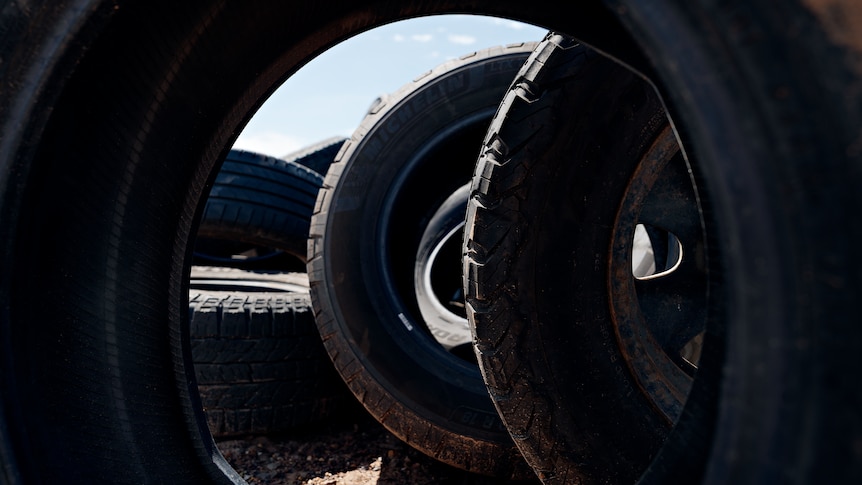
Researchers are hoping to discover the key to stronger roadways through their tyre recycling work. (ABC News: Michael Franchi)
Repurposing old tyres may be the key to building stronger, longer-lasting roads to handle the Northern Territory's harsh climate, say researchers.
About 400 tonnes of tyres are discarded by Darwin residents and commercial operators every year.
They are dropped off at Shoal Bay Waste Management Facility, stored, then sent interstate or overseas for recycling.
But researchers at Charles Darwin University (CDU) are investigating whether recycled materials, including granulated crumb rubber from ground-up tyres and plastics, can instead be used to improve NT roads.
CDU has been collaborating with the NT Department of Logistics and Infrastructure to test this theory since late 2021.
PhD student with the university, Ramin Shahbazi, said flexible materials — which bend and flex under the weight of traffic — were often used in the road construction process.
But he said a different approach was needed in places such as the NT, where extreme weather conditions proved challenging.
"When we have a flexible pavement made of asphalt, it's constantly changing when it's exposed to hot weather and moisture from the rain," he said.
"We wanted to try and replace regular material that was being used in the pavements with recycled alternatives — but try to keep the performance as it is, or also maybe improve it."
Reclaimed asphalt, crushed glass, recycled concrete and crumb rubber from tyres and plastics are being tested with the aim of improving road durability, a Department of Logistics and Infrastructure spokesperson explained.
Senior CDU engineering lecturer and PhD supervisor, Ali Rajabipour, said both council budgets and the environment would benefit from giving the alternative materials a new life.
"Some countries [burn tyre waste], that's not the best way to use crumb rubber … it produces fumes, which are not very healthy," he said.
Dr Rajabipour said the NT could save about $2 million a year by recycling materials dumped in landfill.
Circular economy is the goal
The City of Darwin has committed to a "circular economy", where waste materials are reused and recycled.
But the council's head of environment and waste, Nick Fewster, said achieving that goal could be logistically challenging.
Mr Fewster said repurposing disused tyres locally would reduce the environmental impact made by freight activity as transporting waste — including sending materials off-shore for processing — produced carbon emissions.
"We're all about diverting waste from landfill and reusing materials where possible as part of the circular economy," he said.
But waste management is only part of the equation.
Council's head of infrastructure, Nik Kleine, said Darwin roads faced unique weather challenges across both the NT's wet and dry seasons which could shorten the life span of road surfaces.
"You'll see cracking, you'll see potholes," he said.
Mr Kleine said the CDU trial was an opportunity to give new life to products that would otherwise be sent to landfill.
What happens next?
If the research proves successful, Mr Kleine said City of Darwin would consider trialling the recycled materials in local roads.
"It's done through a tender process … and [this project] would definitely tick the sustainability and environment box," he said.
Filippo Giustozzi, professor of civil and infrastructure engineering at RMIT University, said the investigation aligned with existing evidence on the benefits of crumb rubber in asphalt — but warned its effectiveness would need to be proven under territory conditions.
"Challenging environments like the Northern Territory — with extreme heat, UV exposure and intense tropical rainfall — require site-specific testing to confirm durability, ageing behaviour and moisture resistance over time," he said.
Professor Giustozzi also said recycled plastics were still relatively new in road construction and often needed to be combined with traditional materials to ensure long-term performance.
The NT Department of Logistics and Infrastructure said laboratory testing was about 75 per cent complete, with more than 8,000 tests conducted so far.
Road trials using recycled materials are expected to begin early this year.
ABC