Australia Weather News
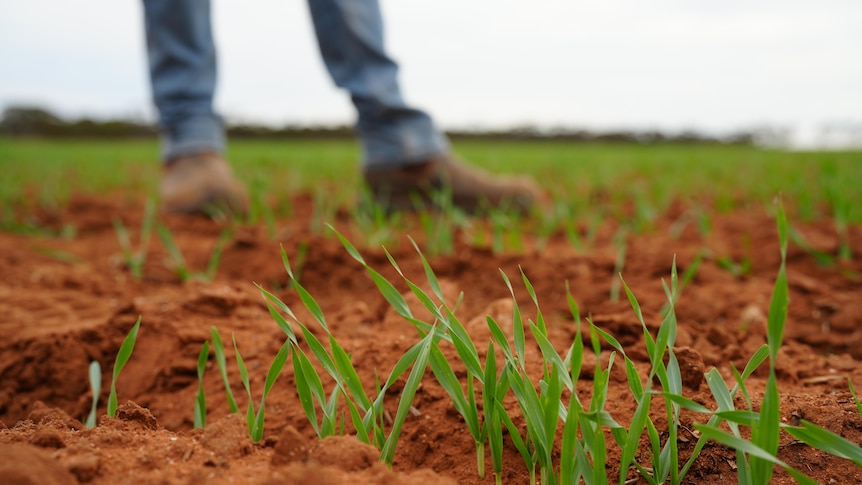
Green shoots give farmers hope after years of drought in South Australia's Mallee and Riverland regions. (ABC Rural: Eliza Berlage)
In paddocks that were dry and patchy 12 months ago, green shoots of hope are sprouting after "decent and meaningful" rainfall across parts of South Australia.
Sam May is a fifth-generation farmer whose family grows a mix of wheat, barley and lentils at Pata in the state's Mallee region, typically a low-rainfall area.
Last growing season, after a couple of tough years of drought, he scaled back their farming operations and reduced fertiliser inputs.
"We went in fairly confident last year that it was going to rain … [but it] didn't turn out unfortunately, so we pulled back a little bit, but not as much as we really should have," he said.
But after 230 millimetres of rain since January this year, including 40mm last weekend, Mr May was feeling optimistic about the season ahead.
It is already more than double what his property received last year, when he recorded less than 100mm.
In early March, he was shocked to find a flood on his home property after 135mm of rain fell over two days, with 90mm falling in just two hours.
"None of my parents or grandparents have seen a [flash] flood like that," Mr May said.
"I don't remember the last time we had meaningful rain [before then], so it definitely boosted the confidence with going ahead and planting this year.
"We're not out of the woods yet, but hopefully we can have a decent season and just get some at least average rainfall from now until harvest."
More rain needed
About 60 kilometres north in Wonuarra, near Paringa, fifth-generation farmer Lia Rover and her family grow vetch to feed their cattle.
The cattle have become one of the most valuable commodities in their mixed farming operation, which includes citrus and almonds.
While the farm has received about 155mm of rain so far this year and there was greenery around, she said conditions were still tough after several years of drought.
"Any [shoots] under 10 centimetres really isn't beneficial for stock [because] there's no protein in it, it's just more water," Ms Rover said.
"When stuff starts to get a foot tall, that's where all your nutrition is, and that's the benefit."
The ongoing drought led to issues with sand drift, with the family spending precious time and money grading and re-grading the soil every time a big wind blew.
"All our sandy hills look more like the moon than a hill, they're that bumpy," she said.
Ms Rover said locusts had also become a problem in recent months, with more than 200 hectares of crops intended for feed eaten by the pests within a week.
"My top farm, you would think I'm breeding them, they are everywhere, it might as well be snowing grasshoppers," she said.
"Our bottom farm's not as bad, but I think because it's just dirt out there."
Cautiously optimistic
Brian Lynch, senior agronomist at Elders Loxton, said more rain fell in his town from January to mid-May this year, compared with all of 2025.
"Last year, a lot of people stopped sowing halfway through, or they abandoned those more high-risk crops like lentils and chickpeas," he said.
"We've had enough [rain] already … for people to actually commit to those [crops] this year.
"Once you've got the rain, all options are open to you."
Mr Lynch said farmers were keeping an eye on the low-level locust migration detected in the Riverland and Mallee.
But he said things were faring better than in other farming regions, which had been inundated with mice and slugs.
"It looks like there is some low-level [locust] egg laying going on, so we're going to have to monitor that into springtime," Mr Lynch said.
Back among the cattle, Ms Rover was feeling committed to her farming future, with reinvigorated energy after the rain.
"I've only ever wanted to be a farmer," she said.
"I don't want to walk away from it, so you've got to do everything you can to stay in the industry."
ABC