Australia Weather News
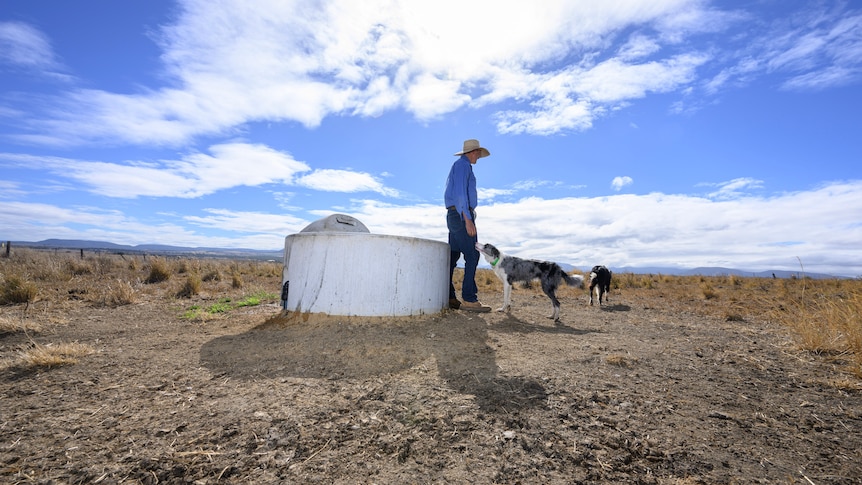
Dugald Spencely is destocking at his Junabee farm as the unusually dry conditions continue. (ABC Rural: Brandon Long)
While parts of Queensland are still drying out after the state's wettest summer in 15 years, a very different story is unfolding in the south.
Across the Southern Downs and Goondiwindi, conditions are unusually dry.
Karara, about 200 kilometres south-west of Brisbane, recorded its second-driest summer on record, with just 94 millimetres of rain, according to Bureau of Meteorology (BOM) senior climatologist Zhi-Weng Chua.
And there is little sign of relief, with the bureau this week revising its outlook to show only a 35 per cent chance of above-average rainfall across Queensland from April to June.
There are no official drought declarations statewide but many producers on the ground say it is starting to feel like one.
It has prompted many farmers to be proactive and encourage others to do the same, making decisions early and adapting before it is too late.
First-time farewell
At Junabee, near Warwick, Dugald Spenceley made his first tough decision as a grazier: selling off most of his family's animals.
After just five years in the livestock industry, he has sold about 120 cattle because the lack of effective rainfall over the past eight months means the grass simply can not support them.
"It's mixed emotions," Mr Spenceley said.
"You do have an emotional attachment to the animals but also your business."
The hardest part was deciding what to do, but the stress eased once he committed.
The family has kept a small number of cattle and may reduce numbers further, including the sheep, as winter approaches.
Their goal, he said, was simple — protect the land now so it could bounce back later.
"It's never nice and you [don't always] get it right, but a plan is always better than reaction in many instances," Mr Spenceley said.
Why the disparity?
According to BOM, the split between a wet north and dry inland south is due to weather patterns.
Between December and February, northern and central Queensland were hit by multiple tropical systems, including cyclones and inland troughs that brought heavy rain.
But those systems did not reach the southern inland districts.
As a result, the southern Darling Downs has been among the driest areas in the state.
"[It's] been that area that's seen the most dry conditions over the last four months, being in the bottom 10 per cent of the historical record," Dr Chua said.
Selling while it counts
At Karara, a rural town nearly 100km south-west of Toowoomba, creeks and dams are drying up across livestock producer Bruce McLeish's property.
Paddocks that would normally have tall bluegrass are thin and struggling.
The last significant rain — more than 25 millimetres in a day — was in July.
"That's probably unheard of in this country," he said.
Rather than wait, he is selling his cattle early while they are still in good condition and prices are strong, with a full destock a looming option.
"You've got to think ahead," he said.
"If the market's strong and your stock is strong, you're better to probably take it now than wait till you're halfway through the winter."
Having lived through previous dry years, including the 2019–22 drought, he said many farmers were being more proactive.
"We're pre-empting it this time".
'Kilometres of pipelines'
At Lyra, about an hour south of Karara, David Andreatta put infrastructure in place to overcome some hurdles.
His tomato and capsicum farm depends entirely on irrigation, and with little rain since November, he had to get creative.
He built a temporary 7km pipeline to pump water from a neighbour's property.
"There's a lot of farmers with kilometres and kilometres of pipelines running around the district," he said.
It pushed up costs, he said, but it was working.
And despite the tough conditions, his crops are performing well.
"Our quality has probably never been better," he said.
"Yields on tomatoes are probably higher than normal."
But it has not been enough to allay concerns he has for the future, especially if dry conditions continue into next season, which could impact jobs and production.
Winemakers are perhaps faring the best in the dry times.
In Ballandean, vineyards have just wrapped up their fourth strong vintage in a row.
Even with heat speeding up the growing process, the results have been impressive.
"In a year full of challenges, we've produced fruit and wines we can all be proud of," winemaker Leeanne Puglisi-Gangemi said.
Despite the dry, Dugald Spenceley knows tough seasons do not last forever.
While pulling back in some areas, he is moving forward in others — even expanding by buying a neighbouring block.
"We've still got confidence," he said.
"People have got to eat."
ABC