Australia Weather News
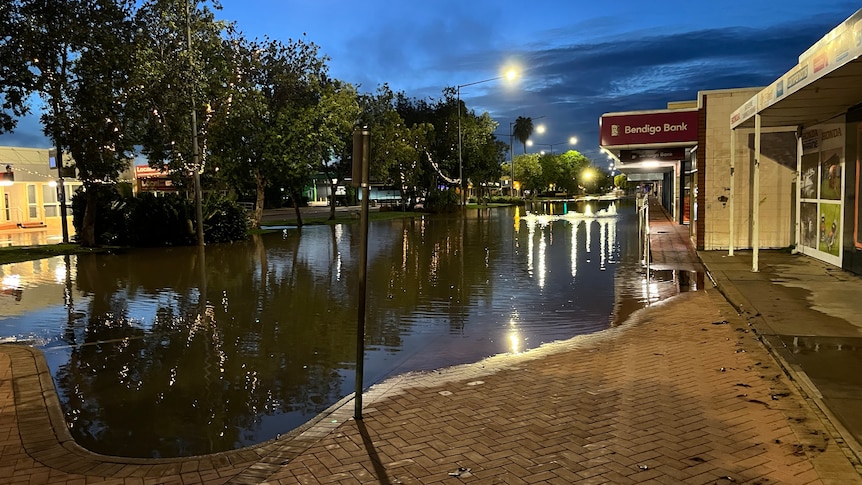
Floodwaters have spilled across parts of Katherine Terrace, alongside the Stuart Highway running through the centre of town. (ABC News: James Elton)
As floodwaters continue to rise in the Northern Territory town of Katherine, the Bureau of Meteorology (BOM) predicts northern Australia will record one of its wettest seasons ever.
NT Police Incident Controller Commander Shaun Gill has warned "the whole of Katherine is under threat now", with two flood rescues carried out in Katherine overnight, "where people were trapped into houses".
He urged Katherine residents to enact their household emergency plans now.
"If you're a person and you feel like you can't get to or you don't have the services now is the time to move to a shelter," he said.
"I don't want to be overly specific on it but it's houses under threat, it's houses under water."
He said he did not yet have information about how many homes have already been affected by floodwater.
"The flood conditions are only going to get worse in the short term," he said.
BOM's Shenagh Gamble said Katherine River was "slowly reaching a peak" with flood risk expected "to stay above major" levels until Sunday.
"So the Katherine community or township, is around 18.62 metres right now," she said.
"[It] is expected to reach a peak of 19.2 metres during tonight.
"Once those river heights have peaked, we expect it to stay above major at the Katherine community and township for about 24 hours, so we expect it to stay above major through the weekend into Sunday."
Residents in the small community, 317 kilometres south-east of Darwin, woke up to find their main street had been submerged by flooding — despite advice from authorities yesterday that the centre of town would not be inundated.
On ABC Radio Darwin this morning, NT incident controller Shaun Gill said six aircraft were now helping evacuate the remote community of Palumpa by air.
Evacuees will be staying at Marrara in Darwin, while Daly River (Nauiyu) resident are expected to be evacuated to Foskey Pavilion at the city's showgrounds.
Locals in the remote Indigenous community only returned home late last month, after earlier rains caused Daly River to flood.
He said Katherine River was expected to peak around 19.2 metres today, which would likely submerge the town's high-level bridge.
The river reached the major flood level yesterday, with BOM reporting floodwaters at Katherine Bridge passed 18.6 metres around 8am this morning.
BOM warned these kinds of "rapid river level rises" would continue as "further rainfall is expected during Saturday".
BOM said "major flooding above the April 2006 flood level" — when the river peaked at 19 metres — was occurring this morning at the entrance to Nitmiluk Gorge.
Katherine's flood emergency warning was triggered yesterday, with the local hospital evacuated and closed, the Stuart Highway cut off and emergency shelters set up.
Around 200 people across the Katherine region were sheltering in local schools as of this morning, and levees north of the town had been activated.
Local landscaper Ben Hockey has been up since well before dawn, frantically helping distribute sandbags to fellow businesses on Katherine's main street.
He's working alongside a small group of dedicated locals, but told the ABC they don't have enough sandbags or volunteers.
The local SES has been in touch with Mr Hockey to try to coordinate sandbagging efforts.
Meanwhile, flooding subsided in Beswick overnight, with an evacuation centre there — located on higher ground — opened to those in need yesterday.
It comes as a tropical low hovers over large parts of the Top End this weekend, with BOM forecasting this wet season could become the 10th wettest on record.
Tropical low brings rainfall
BOM senior meteorologist Rebecca Patrick said the bureau was monitoring tropical low 31U, which had made landfall north-east of Katherine.
She said, while there was a "low chance" of the weather system developing into a cyclone, heavy rainfall across the Top End was possible.
"As we see that tropical low move from the Gulf of Carpentaria across the Top End, we might see an increase in rainfall," she said.
The BOM's track map shows 31U is expected to sit near Katherine today, stretch in opposite directions to cover Daly River in the west and the remote community of Ngukurr in the east — splitting the weather system in two — on Sunday, before it is forecast to reform and dump rain as far north as Batchelor and southern parts of Darwin tomorrow afternoon.
It is not the first tropical low over the past fortnight to bring heavy rainfall, with one stalling over Central Australia in mid-February before travelling further south last weekend.
BOM's Felicity Gamble told ABC Radio's Country Hour program earlier this week the "stationary system" had drawn in moisture from the north and dumped "very high rainfall totals" across the outback.
One of the NT's wettest seasons
Ms Patrick said the Top End had experienced "a fairly consistent and active wet season", while further south December and January in the NT had been "relatively dry".
But she said last month was a different story.
"We had a number of heavy rainfall events with thunderstorms, as well as that tropical low that moved southwards and sat around the south-eastern parts of the territory for basically the second half of February and dumped a lot of rainfall," she said.
"In the southern parts of the NT, we've seen rainfall more than four times the amount that we'd normally see in February."
Alice Springs was one of the locations to experience quadruple its typical monthly total, with 188mm of rain falling in February.
It meant the usually bone-dry Todd River in Alice Springs has been flowing since early last month, breaking its banks and impacting properties and local infrastructure.
While emergency-level flooding in the town subsided this week the wet weather has continued, and several unsealed roads have been left unusable — cutting off remote communities east, north and west of Alice Springs.
Shane Hamilton, the chief executive of national not-for-profit Aboriginal Hostels Limited, told ABC Radio Alice Springs some Territorians were still stranded in town and needed accommodation.
On Wednesday he said the temporary, affordable housing offered by the service had been at capacity for weeks.
"In the two weeks leading into the big rain, [and] once it actually hit we were inundated with calls from people looking for a bed," Mr Hamilton said.
"For example, we've got a young woman who had a baby in late January and hasn't been able to get home. She's still with us, waiting for the water to go down and roads to open."
Kurundi, south-east of Tennant Creek, saw 569mm of rain across last month which the forecaster said "far surpasses" the station's previous record of 383.7mm from the year 2000.
"Across northern Australia, it is tracking as our 10th wettest wet season on record," Ms Patrick said.
With March expected to continue bringing "above-average rainfall", she said the season could still progress to a higher place on that record ladder.
As the monsoon trough shifts further south, Ms Gamble said the bureau expected it "to bring quite a lot of rainfall".
She said March is expected to see "the last burst of this wet season" before the NT moved into the dry season from May.
ABC