Australia Weather News
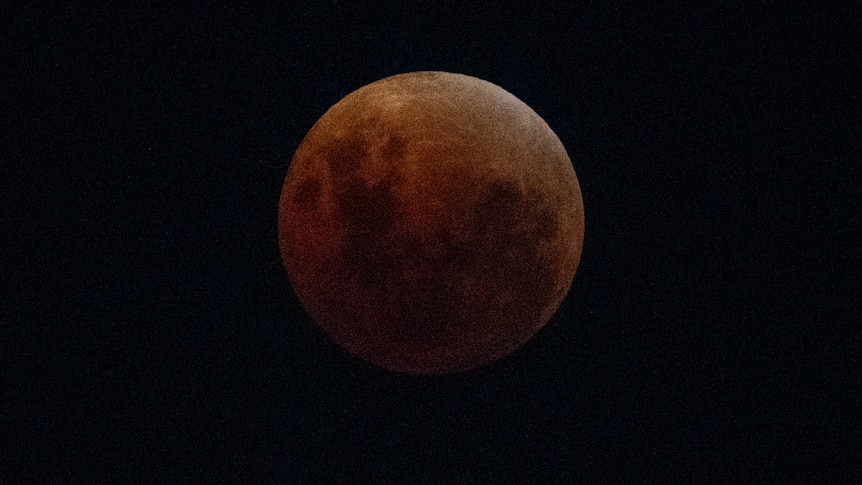
The reddish-orange moon is captured from South Perth. (ABC News: Andrew O'Connor)
Stargazers came out in droves on Tuesday night to see the Moon tinged with a reddish-orange hue in their last chance to see a total lunar eclipse for almost three years.
Perth and southern Western Australia were among the best spots in the country to see the blood moon.
The eclipse was in totality for about an hour from 7pm in WA, transforming the Moon from its normal neutral colour to a warm reddish-orange.
While taking place at the same time, the time difference meant it was a later local viewing time for Melbourne, Sydney, Canberra and Hobart, with totality — when the Moon is completely in the Earth's shadow — starting just after 10pm.
For Adelaide, totality started just after 9:30pm, for Brisbane it was around 9pm and in Darwin it was just after 8:30pm.
Since the Moon rose from the east, people viewing the event from Australia's east coast saw more of the partial eclipse in the lead-up to the Moon turning red during totality.
And in the west, it meant once the Moon was visible, it was in its full reddish-orange glory, seen with the naked eye or camera lens.
According to astrophysicist Graham Jones, this event marked the end of a run of lunar eclipses, and a turning point towards more solar eclipses over the next few years.
"We see a pattern in eclipses where for a couple of years we get a very nice run of big lunar eclipses, and then the balance shifts and we have a few years of very nice solar eclipses," he said.
What is a lunar eclipse?
A lunar eclipse happens when the Earth passes directly between the Sun and Moon, and Matt Woods from the Perth Observatory said it could only occur during a full moon.
"The Moon goes into the shadow of the Earth and it turns blood orange," he said.
"Some of the sunlight still passes through the atmosphere of the Earth, and our atmosphere is blue because of the oxygen and nitrogen particles in the atmosphere scattering the blue light of the sunlight, and then what's left over is the yellow and red light and that continues and hits the Moon.
"When you mix yellow and red, you get orange … the actual process is called Rayleigh scattering."
How rare is a lunar eclipse?
The last time a blood moon occurred was a few months ago in September 2025, but stargazers in Perth were left disappointed as most of it happened during cloud cover, with the total lunar eclipse before that taking place in 2022.
Mr Jones said only about half of the world could see a total lunar eclipse at a time, but it was still more parts of the Earth than during a solar eclipse.
"To see a lunar eclipse, you have a much better chance than seeing a solar eclipse," he said.
"A lunar eclipse is visible from anywhere on the night-time side of the globe."
Mr Woods said a lunar eclipse "can be quite rare", but it reminded stargazers it was easy to view.
"The great thing about total lunar eclipses is that you don't need any specialised equipment. If you do want, you can use your telescope or binoculars, but for this one you just need[ed] clear horizons to the east," he said.
When is the next one?
The next blood moon is set to take place in about two years and 10 months.
Mr Jones, who described lunar eclipses as "something really magical", said it would be "a really cool date" starting late on New Year's Eve 2028 or early morning on New Year's Day 2029, depending on local time.
It will be a special viewing for Perth, since the eclipse itself will start on December 31, 2028 and finish early on January 1, 2029.
For people on the east coast due to the time difference, it will already be 2029 when the lunar eclipse starts.
And for the next total solar eclipse, July 22, 2028 is the big day where parts of northern WA like Kununurra will be in the path of totality, along with Sydney.
[Share your photos/videos of the eclipse with us]ABC