Australia Weather News
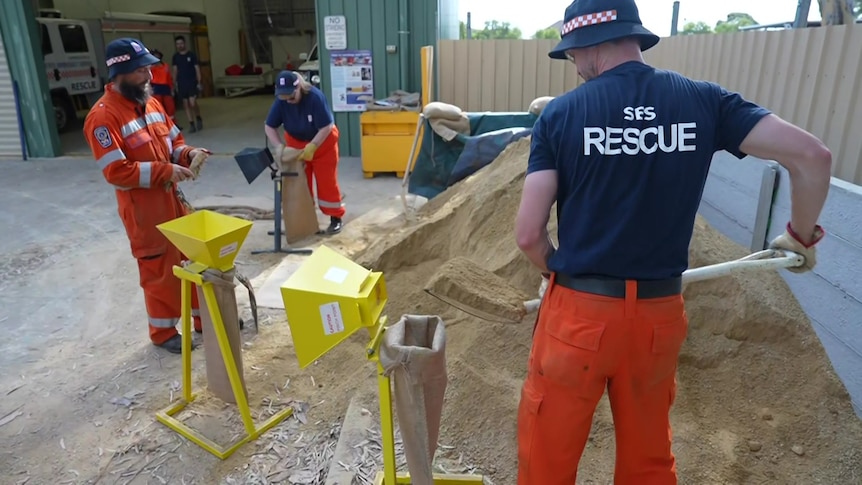
State Emergency Service crews have been sandbagging ahead of forecast wet weather. (ABC News)
Adelaide could receive its most rain in one day in nine years on Sunday, as the Bureau of Meteorology says the downpour is certain to set records in parts of South Australia.
The Bureau of Meterology said between 5 to 10 millimetres of rain had fallen across Adelaide between 6am and 7am on Saturday.
Severe weather warnings are in place for large parts of the state, along with flood watches and warnings in certain areas.
On Friday, Bureau of Meteorology meteorologist Jonathan Fischer said a tropical low that had caused heavy rain in the state's outback was set to move south and collide with a trough sweeping east across the state on Sunday afternoon.
He said this would result in heavy rain and possibly flash flooding.
"We don't just have the risk of nuisance flooding, we have the risk of intense rain and potentially life-threatening flash flooding," he said.
"We will see flooding; just exactly when and where is the question."
The bureau is forecasting totals of 100 millimetres could fall in some parts of the state — more than the 61mm that caused flooding in Adelaide in December 2016 and 75mm in February 2014.
Mr Fischer said it was almost certain multi-day rainfall records would be broken somewhere.
"Even if Adelaide doesn't get hit, other parts ot the state likely will," he said.
The Bureau of Meteorology's Dean Narramore said some areas of the state have not seen rainfall for months.
"It's been a very dry summer," he said.
"Some areas could see a summer's worth of rainfall in just a few days and multiple summers in some areas once we start talking about falls in excessive of 100 millimetres."
Premier Peter Malinauskas urged people to get ready for the downpour.
"There are some simple actions that we would ask South Australian households to turn their minds to if they haven't already," he said on Friday.
"There is still a narrow window, although it is getting tighter for people to turn their minds to basic actions to prepare their homes — clearing their gutters, making sure drains are unblocked so that rain and water can flow as is appropriate."
Both the premier and acting State Emergency Service chief officer Kristy Phelps urged people to be careful in floodwater.
"We have seen reports of people driving through floodwaters as well as kids playing," Ms Phelps said.
"Again, I remind people that it's incredibly dangerous.
"When you approach the floodwater, it's difficult to tell how fast moving it is and there's often a lot of debris and wildlife like snakes."
The SES is providing sandbags at locations both in Adelaide and regional areas.
The rainiest day on record in Adelaide was February 7, 1925, when 141.5mm fell in a 24-hour period.
'Never seen this much rain at once'
Nicola Jane Williams lives on a remote property in Charra, 40 kilometres west of Ceduna.
She said both her rainwater tanks had overflowed.
"My road in and out of my house is now cut off," she said.
"I've never seen this much rain at once in 30 years on [the] Eyre Peninsula."
Roanne Scholz said she recorded 101mm in less than 12 hours at her property west of Minnipa, about 175km east of Ceduna.
Ms Scholz said the torrential rain had left her with "goosebumps".
"We've only ever seen 50mm drop in one rain event … to get 100, over 100, like it's still raining, it's just going to set us up for an amazing year," she said.
Ms Scholz said she heard people in the Poochera area had received about 70–100mm of rain, which was "just unheard of".
"No-one has ever seen this much fall in such a short amount of time," she said.
Ms Scholz said, on average, her area only received about 300mm a year.
"It's surreal. I don't think it's even really hit home yet," she said.
"The smile, I can't take the smile off my face — I'm in a very happy community this week."
After the tough drought conditions of last year, Ms Scholz said she just broken even grain, and had to sell roughly 30 per cent of her cattle.
She said the heavy downpour was a welcome relief, allowing them to maintain stock levels and seed early.
"We'll probably be able to start seeding earlier, which is super handy," she said.
"It'll also mean we can keep our cattle … we can keep our herd probably at the size it is now. We don't have to cull down."
ABC