Australia Weather News
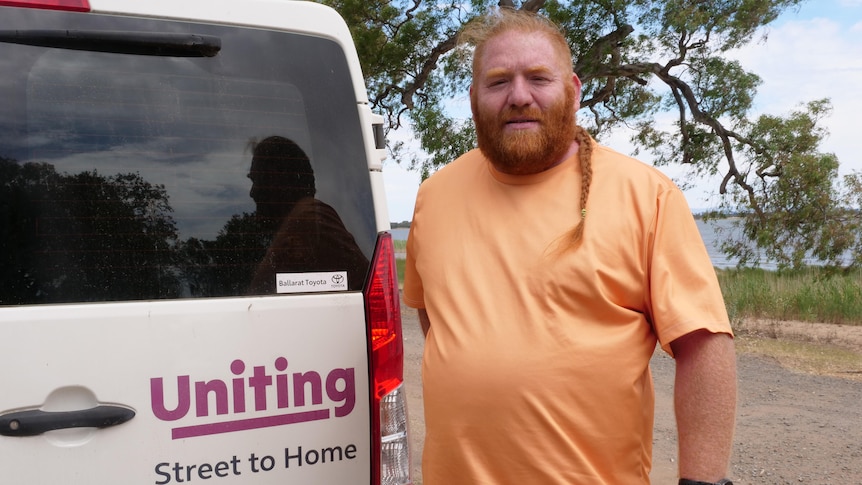
Michael Bull says it was stressful trying to warn as many rough sleepers as possible. (ABC News: Charlotte Wilkes)
On January 9, the Ballarat region in Victoria sweltered as the mercury edged past 40 degrees Celsius.
Fires burned in the nearby towns of Skipton, Streatham, Carranballac, Bamganie, Meredith and Mount Mercer.
Two hundred and ninety-one warnings were issued on the VicEmergency app, the most ever in a single day.
Just days prior, two outreach workers had raced against time in an effort to reach every homeless person in the bushland around Ballarat to warn them of what was coming.
According to community services organisation Uniting, there are more than 200 rough sleepers in the Ballarat region that they know of.
More than just a shelter — it's home
John, 71, is among those classified by Uniting as a "rough sleeper", though he has a more homely set-up than some.
He has three tents — one is a kitchen, one is where he sleeps and one is for storage — at a free lakeside camping site 20 kilometres west of Ballarat, where he has lived since November.
Prior to that he lived at a similar site at Green Hill Lake in Ararat for 10 months.
"At 71, I've made peace with that; this is my life," John said.
"I have my pantry, my fridge, I live out of here.
"The rest of it, the mats and things, are not important I guess, but they just make it feel more like home."
But despite his few creature comforts, living in a tent during extreme heat can be brutal.
"If it's cold you can put a jumper on or an extra blanket, but in the heat … it can crush you," John said.
He said he struggled in early January, enduring three days above 35C.
"The hot weather was really, really hard, day after day," he said.
"You have no air-conditioning, no fans, you just have to ride it out."
On top of this, the campground has no running water and the lake water isn't safe to drink, so John relies on a friend in Ballarat and outreach workers to give him water.
Rough sleeping near a bushfire
By January 9, bushfires were popping up around the region, with the closest just 20 kilometres from John's camp.
"The bushfires did worry me," he said.
"I noticed a number of campers left, because there was a Watch and Act alert for here.
"But the fires were far enough away that I didn't panic, even though there was a lot of smoke.
"Come Friday night, the glow from the fires was enormous."
John suffers from multiple health conditions, which means he no longer has a licence, so on catastrophic fire danger days, he has no transport or means to escape if there is an emergency.
Choosing to stay
There are many in similar situations to John, which is why days before the heatwave hit, outreach workers started visiting and calling as many rough sleepers as they could to make sure they had time to prepare, had enough water and to offer them an air-conditioned motel room for the night.
Uniting team leader Juelz Sanders said many homeless people often declined the offer of motel accommodation, as it would leave their camps and belongings vulnerable to theft and fire.
"This is their home and asking them to leave can be difficult," Ms Sanders said.
"They're leaving their home, just like someone leaving a property — they water it down, they prepare it, they do the best they can and they make that decision whether they stay or leave.
"And it's exactly the same for someone who is rough sleeping — their campsite is their house so asking them to leave can be a really stressful thing."
A race against time
The team at Uniting Ballarat had just two days to warn rough sleepers within a 450km radius before temperatures meant it would be too dangerous for workers to go out.
Ms Sanders said it was an impossible task.
"It is time limited so there is a lot of pressure on the team," Ms Sanders said.
"We rely heavily on councils and [DEECA] to let us know where people are — the bush areas are really big so without some kind of pin it can be difficult to find them.
"We are aware we didn't get anywhere near to everyone in our area … but it's the best we could do with the resources we have."
Ms Sanders said that after that, all workers could do is sit and worry and hope for the best.
"We go home to our houses and our families, but it doesn't mean we don't think about those people who chose to stay," she said.
"We're losing sleep about those people and waiting for Monday to contact them to make sure they're OK.
"It's hard, but who else would have done it?"
On the ground
Michael Bull was one of the two outreach workers covering the Ballarat region in person.
"We would come out and engage with everyone in a camp, it didn't matter if they were there on holiday or living there, because everyone had to have the same kind of information," he said.
"All up, that was over 2 hours of driving around from place to place, talking to well over 100 people."
Some rough sleepers did not know what day it was, so Mr Bull said explaining what was happening and when to expect it was very important.
"We would go there and make sure they had the fire emergency app, that they're aware the hot weather was coming, and, in case of emergency, what their plans were," Mr Bull said.
"We also couldn't just take everybody to a hotel, because there are budgetary [constraints] and it's in the holidays so there's a lack of rooms.
"So we had to sit there and say, 'Who is the most vulnerable?' and make decisions of who can we actually access, and who gets the first offer."
A call for more funding
Ms Sanders said the heatwave was an unplanned event, so putting homeless people up in motels came out of Uniting's budget.
"We spent nearly $20,000 on accommodation and supplies for that one week," she said.
"It's a lot and it's money we haven't planned for, but we need to make sure these people are safe."
Council to Homeless Persons CEO Deborah Di Natale said there needed to be more funding for so-called "assertive outreach workers" that went into the community and met people where they were.
"When someone is sleeping rough and we have bushfires, to me that is very clearly a crisis situation," Ms Di Natale said.
In the Wimmera, there is one assertive outreach worker for the whole region and they are funded by local councils rather than the state government.
"What we need is a commitment from the state government that we will get assertive outreach workers in every part of regional Victoria where they are needed," Ms Di Natale said.
“Bushfires are one of the most stressful times for assertive outreach workers because they know people are sleeping rough, and they know they're going to be very unsafe if they continue to stay there.
"We know people who are rough sleeping will get the biggest impact if they manage to connect with an assertive outreach worker."
ABC