Australia Weather News
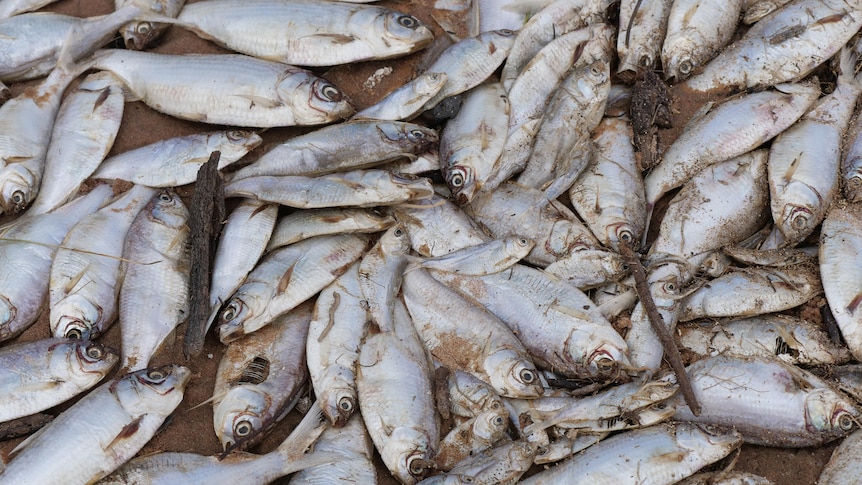
Thousands of native bony bream were found dead at Sunset Strip. (ABC Broken Hill: Coquohalla Connor)
A fish kill has been found at Sunset Strip, a community on the bank of Lake Menindee in far west New South Wales.
Residents first became aware of the event on Monday afternoon, finding tens of thousands of dead fish, mostly native bony bream and some carp, lining the river banks.
It came after a week of record-breaking heat, followed by a sharp decrease in temperature.
The discovery was less than three years after a mass fish kill in which tens of millions of native species were found floating along the nearby Darling River.
A shock, not a surprise
Darren Clifton was on his way to go fishing on Monday afternoon when he noticed something glittering in the grass.
"We could see these silver flashes and we came down to have a look and found thousands upon thousands of dead bony bream," Mr Clifton said.
"[I was] very shocked … but given the temperature we had over the last week, the bony bream are the first to suffer in any catastrophe."
Mr Clifton was formerly the secretary of the Darling River Action Group, which is no longer active.
He said last week's heatwave, when temperatures peaked near 50 degrees Celsius in some areas, may have contributed to the event.
"The temperature seems to affect these little fellas first," he said.
"Some pockets of water on the other side of the lake have red alerts for blue-green algae; you have to put the two together."
Cleaning begins
The Menindee branch of the Barkandji River Rangers, which blends local Aboriginal ancestral knowledge and modern conservation methods to protect and preserve natural assets like the Menindee Lakes, has been monitoring the nearby waterways after the hot weather.
Barkandji Native Title Group Aboriginal Corporation RNTBC chief executive Luke Driscoll, whose organisation oversees the ranger program, said hundreds of dead fish, mostly carp, had been removed from the Darling River near Menindee last week.
"We ascertained last week that they were coming from the lake, which means there were fish struggling in the lake," Mr Driscoll said.
"We couldn't figure out the actual source [of] where they were dying, [but] obviously it's a very big lake, 3.5 times the size of Sydney Harbour in terms of water."
Mr Driscoll, a Wiradjuri man, said he was not surprised more dead fish had been found after a rapid temperature drop across the region over the weekend, but it did not make the sight any less devastating.
"It's really upsetting to see this many native fish that have been washed up on the shore of this lake [which are] obviously a very important part of our Barkandji culture," he said.
"Estimates are around 100,000 fish, which is something you don't want to see, particularly in this area, which has seen fish kills every couple of years."
Mr Driscoll said more dead fish could be found in other parts of Lake Menindee.
The river rangers are working with Central Darling Shire and the NSW government staff to coordinate the clean-up, which locals said stretched for about 3 kilometres of the lake bank.
In a statement, the New South Wales Department of Primary Industries and Regional Development Fisheries said it was aware of the fish kill and no cause had been determined; however, the weather was a likely factor.
"Recent extreme temperatures and the recent cool change are likely to have a great influence on local water conditions in Lake Menindee as lake levels recede," it said.
ABC