Australia Weather News
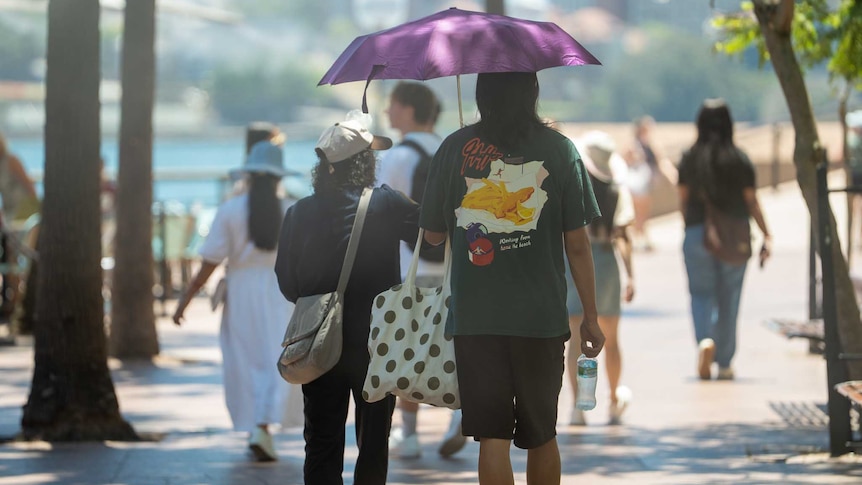
Conditions experienced in the early January heatwave were once rare, but no longer are. (ABC News: Abubakr Sajid)
The intense heatwave in south-eastern Australia in early January was made five times more likely by human-caused climate change, a new international analysis has found, despite La Niña having a dampening effect on its intensity.
The multi-day event was the most severe heatwave the area had experienced since the devastating Black Summer of 2019/20.
For several days in a row, temperatures rose to above 40 degrees Celsius across large parts of the country, culminating in devastating fires across Victoria, which destroyed hundreds of houses and killed one person.
The new study — by international science group World Weather Attribution (WWA) — examined the maximum temperatures recorded in South Australia, Victoria, New South Wales and Tasmania over the three days between January 7 and 9.
It then used historical records and computer simulations to determine how likely the event was to occur with and without 1.3C of global warming.
The analysis found that, prior to human-caused climate change, events like the one just experienced did occur, but infrequently — on average about four times a century.
In today's climate, however, they are far more common — returning every five years.
In other words, the heatwave was five times more likely than it would have been without climate change.
"We know that we've always had heatwaves, but heatwaves are an extreme event. And by that, it means that they should be very rare," Australia National University climate scientist Sarah Perkins-Kirkpatrick said.
"Suddenly they're not becoming so rare after all."
It also found, on the current path of global warming, south-eastern Australia could expect to see a heatwave like that once every two years.
"If you think about an event like this occurring once every two years, that does put stress on our bodies and infrastructure and our ecosystems," Professor Perkins-Kirkpatrick said.
"But it makes you also think about the worst events that will occur more often as well. Maybe not once every two years, but once every four or once every five years, and the damage that they will do to our system."
La Niña buffered temperatures
As for just how hot it got, the study found the temperatures were on average 1.6C hotter in this event than they would have otherwise been without climate change.
During the event, Sydney and Penrith recorded temperatures over 42C, Melbourne Airport hit 44C, Adelaide recorded 42C, and Canberra airport reached 39C.
Even hotter conditions were recorded across regional areas.
But what Professor Perkins-Kirkpatrick said was particularly interesting, was that it occurred despite the presence of a weak La Niña event, which was likely to have provided a buffer to how high the temperatures got.
"So in other words, without climate change, this event would have been much cooler if it occurred at all," she said.
La Niña is a natural phenomenon, linked to ocean temperatures in the Pacific, which typically sees less frequent and intense heatwaves, along with higher rainfall, to large parts of Australia.
Professor Perkins-Kirkpatrick said if its opposite phase — El Niño — had been in play, or any of the other "warm" climate influences, the outcome could have been much worse.
Another heatwave on the horizon
Already, another severe heatwave is on the horizon for south-eastern Australia.
Forecasts show a week-long spell of heightened fire danger and dangerous temperatures beginning from this weekend.
For inland regions, maximums well into the 40s could be recorded for seven consecutive days, including peak temperatures as high as 48C, surpassing both the intensity and longevity of the early January heatwave.
Our capitals will also sweat through another a spell of hot weather, with Adelaide, Melbourne and Canberra tipped to hit 40C during the event.
Heatwaves are Australia's deadliest natural hazard.
They have played a role in setting up some of the biggest fires the country has seen, including the deadly Black Saturday bushfires, and placed acute pressure on Australia's health system.
[table deadliest natural disasters]While the early January heatwave was far from the most severe Australia had seen, and affected a population accustomed to high temperatures, the impacts were still felt.
Hospitals reported a surge in heat-related illnesses, with a 25 per cent increase in emergencies in Melbourne. There were also reports of the heat affecting animals, including koalas and honey bees, as well as bats, who died in their thousands.
Professor Perkins-Kirkpatrick said it underscored the need to reduce emissions — caused primarily by the burning of fossil fuels — and make adaptions in our communities.
"We have to reach net zero, and ideally as soon as possible," she said.
"Unfortunately, that's no longer enough. We are seeing more events like the most recent heatwave. They're going to be more severe. And with that, we must adapt with them.
"Whether it's building better houses, better warning systems, protecting the most vulnerable in other ways, having access to reliable and safe cooling. These are all appropriate adaptation policies and efforts that we need to consider and need to roll out more seriously and faster than what we're currently doing."
ABC