Australia Weather News
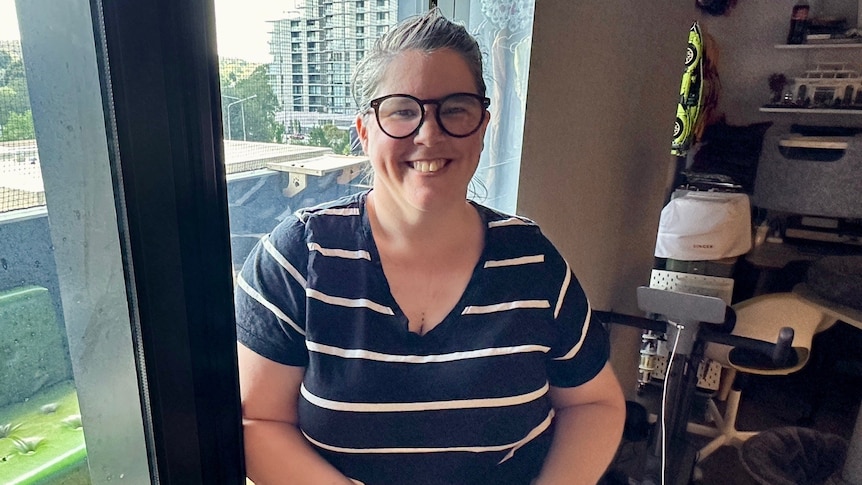
Llewellyn McGarry says when she bought her apartment in Canberra's south she did not realise it would become so hot. (ABC News: Lish Fejer)
Llewellyn McGarry's apartment fitted the bill when she was looking to buy an energy-efficient, accessible dual-occupancy property for her and her mother.
The apartment in Canberra's south has sunset views of mountains to the west, and moving in over winter, Ms McGarry was surprised the floor-to-ceiling windows kept the apartment warm.
But both apartments are now sweltering through summer as indoor temperatures recently surpassed 40 degrees Celsius.
"It was unbelievable for me to think that it was 42 degrees here, which is what it was … at 5:50pm," Ms McGarry's mother Marie said.
"We didn't consider how hot it was going to get.
"It's a concrete building, double glazing, all these sorts of things that told me it was going to be okay [but] it wasn't. It was so hot."
Design challenge
As climate change brings hotter summers and more frequent heatwaves, experts have said it will be essential to better address the living conditions of apartment dwellers.
In the largest study of its kind in Australia, researchers are tracking the indoor temperatures, air quality, and window and air conditioning usage in 450 apartments across Sydney, Melbourne, and Queensland over two years to understand how apartment dwellers actually use energy and maintain comfort.
Over the recent heatwave, researchers, led by senior research scientist Pippa Soccio, surveyed participants to find out how comfortable they were in their apartments.
The results showed 25 per cent of participants felt warm or too hot in their apartments, with a lack of air movement the main problem.
"Very few of [the participants] have ceiling fans," Dr Soccio said.
"It's great to put air conditioning on to cool our homes down, but if we get a heatwave and a power outage and you can't use your air con, then can you open your home?
"Can you get air moving through, particularly when the cool change comes?"
Other causes of uncomfortably hot apartments included inadequate shading, ineffective air conditioning or people's choices not to use air conditioning.
Window woes
Ms McGarry's experience isn't unique. Across Australia, residents in apartments are sweltering for months each year — despite meeting building standards
The hot indoor temperatures were particularly surprising as she had believed her double-glazed windows with a dark tint would have acted as a shield and maintained a comfortable temperature.
"I thought double glazing was about heating, cooling and noise, but as soon as the sun hits the surface, it actually feels hotter on the inside than it does on the outside," Ms McGarry said.
"You put your hand on it, it's so hot. It feels like it could burn."
But building scientist Peter Lyons said, depending on the climate, glazing could be a trade-off between overheating in summer and free heating in winter.
"If you've got huge, glazed areas, particularly if they face west and are sheer facades with no shading, then those windows cop a huge amount of solar heat," Dr Lyons said.
"You might actually benefit from some of that solar gain in the winter, but the downside is they are going to be a liability in the summer."
It is a design flaw repeated across Australian apartment buildings, which is part of the CSIRO's Apartment Energy Behaviour Study.
"There's a belief, I believe, that more glass gives us more access to daylight and daylight is preferable over artificial light," he said.
"[But] depending on your orientation, more glazing and daylight means more sunlight, which in turn means more radiant heat, which then obviously heats the apartment."
"I think it's great to use glazing, perhaps to frame a view rather than to necessarily capture the entire view," Dr Soccio added.
Limited solutions
Ms McGarry has installed internal blinds programmed to come down in the afternoon when the sun strikes.
In the bedrooms, she has added accordion-style blinds with reflective backing fitted into the window frame.
She said the additions had helped, but it was still too hot, and that even when the air conditioner was set to 19 degrees Celsius, the temperature rarely dropped below 24.
"It has improved in comparison to my mum's, but it's still quite hot in there. It was 30 degrees on Monday," she said.
Her energy bills are now costing up to $300 per month, which she said was higher than expected but also a medical necessity as she lives with a disability.
"As someone who can't regulate my temperature, anything above 24 [degrees Celsius] is actually incredibly uncomfortable, and I get quite ill," Ms McGarry said.
"We were after something long-term, like a forever home, that was going to be suitable to meet everything I needed and what mum needed … but we're just too hot."
Looking across at the new developments around them, Ms McGarry and her mother contemplate the prospect for future residents with floor-to-ceiling glass on all sides.
"These poor souls, they get the morning sun from this side of the building, and then they'll get the afternoon sun as well, so they'll get it all day and be cooked," Marie McGarry said.
ABC