Australia Weather News
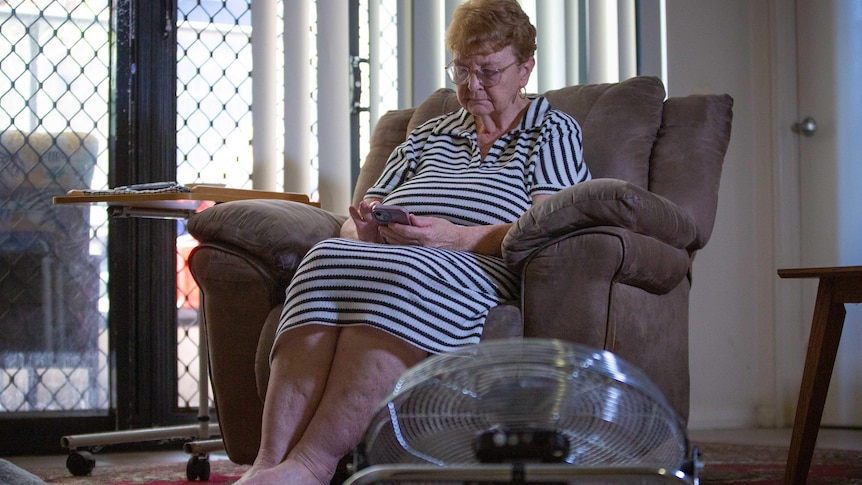
Public housing resident Debbie Mitchell sits in front of a fan trying to keep cool as temperatures soar across parts of the country. ()
Emergency departments, medical centres and first responders are grappling with a surge in heat-related illness across Australia's south-east as temperatures soar to near record levels.
The risk intensified in parts of Victoria where tens of thousands of homes lost power during catastrophic bushfire conditions.
In Melbourne, where the temperature spiked above 40 degrees, one major hospital reported a 25 per cent increase in potentially fatal heat-related presentations overnight.
?The Royal Melbourne Hospital has seen "really acute" issues caused by the extreme heat, according to director of emergency medicine Mark Putland.
"In recent nights, we've seen significant increase in overnight presentations perhaps up to around 25 per cent," Dr Putland said.
"That's all to do with it being a rotten hot night and people struggling to sleep, feeling sick, developing symptoms … and coming in for care."
He said an increasing number of people were presenting to the emergency department, including the elderly, those who did not have air conditioning in their homes, tradespeople and patients with existing medical conditions.
"The most obvious is heat stroke and that's what we see when someone's just so exposed to heat that their body loses the ability to cool itself and they actually become really hot inside," he said.
"So that's extremely dangerous."
Increase in presentations in NSW, SA
It is a similar story in Sydney where conditions are expected to intensify tomorrow.
"We're seeing a lot of elderly patients that don't stay well hydrated … so they're very fragile," said Gonzalo?Aguirrebarrena, acting director of emergency at St Vincent's Hospital.
He said babies, young children, pregnant women and people with kidney or heart conditions were also at risk, along with those who underestimated the risks associated with a heatwave.
"People that are very healthy and very fit and they continue doing their normal life and they go to exercise, peak heat hour, like any other normal day and they don't realise that they become vulnerable during those times."
On Wednesday and Thursday, 33 people presented to an emergency department for heat-related illnesses, including heat stroke, sunstroke and heat exhaustion, NSW Health said.
The department said heat, "can also exacerbate people's underlying health conditions (including heart, kidney, respiratory disease, diabetes and mental illness) and can result in people presenting to hospital emergency departments and other health care services".
Dr Kavita Varshney, Deputy Director of Emergency Medicine at Westmead Hospital in Sydney's west, said hospital data did not always reflect if a patient was heat-affected.
She said some complex conditions could be exacerbated by high temperatures, but would be recorded as a heart or kidney issue instead of heat-related.
She said Westmead Hospital's emergency department had been busier than usual and staff were prioritising people according to their need for care.
SA Health said there were at least 49 heat-related presentations from Tuesday to Thursday, numbers that could increase as local hospitals updated their data.
Dr Putland said emergency health workers provide urgent care when a patient presented with heat stroke.
"It is a number of things: sedation to prevent them moving to minimise muscle activity, active cooling, so misting a person with water, wet sheet, fans and then sometimes more dramatic measures to try and cool someone if they're really, really hot," he said.
"Because you can get so hot that your body actually can't regulate its own temperature anymore and it can start to really, I guess, cook internally and that's a very severe state of affairs that needs very active management."
'Never faced anything like this'
Dr Putland, who also chairs the Victorian branch of the Australian College for Emergency Medicine, said people in rural and regional areas were facing even tougher conditions.
"Their conditions are tougher than they are in in our cities [especially for] people who work on the land," he said.
Port Augusta GP, Saji John, said he had "never faced anything like this".
"My car showed temperature on the dashboard as 49 degrees," Dr John said.
"We had to meet a few patients in the local hospital due to dehydration and causing kidney injury and we've had another patient who had bleeding non-stop from the nose from extreme heat."
Debbie Mitchell has been struggling without air conditioning in her social housing unit in in Sydney's west.
She lives with Parkinson's Disease and is particularly vulnerable in the heat.
"I can't really walk in this heat. It makes me breathless," she said.
"I have problems with my legs, so I worry that I'm going to fall."
She has the company of her French bulldog, Chloe, but after being stuck inside for several days she's finding it difficult.
"It is a bit isolating when you're just sitting at home," she said.
Dr John said he had seen an increase in presentations for mental ill health.
"A lot of these people who have mental health issues, they get angry and agitated because weather patterns definitely actually affects the mental health and mood of a person," he said.
"[I] have a few people presenting to me for help with the anger."
'Cruel reality' for disadvantaged communities
Australian Council of Social Services chief executive Cassandra Goldie said the extreme heat was a "cruel reality" for disadvantaged communities.
?"This heatwave is pushing people who are already struggling right to the brink … people are having to choose between putting food on the table or cooling their homes," Dr Goldie said.
"The cruel reality is that the people most at risk from extreme heat are the same people who can't afford to cool their homes."?
In-home care provider, Just Better Care, has activated its heatwave response plan to ensure any high-risk clients are identified and prioritised.?
"That's anyone that has limited access to cooling, chronic medical or cognitive conditions, or that might be taking medications that are affected by hydration or thermoregulation,"?spokesman Callum McMillan?said.
How hot is too hot for the human body?
Temperatures over 32 degrees Celsius are considered dangerous for a person if the humidity is also high, but in dry heat, temperatures above 40 pose a significant health risk.
University of Sydney professor of heat and health Ollie Jay said it was not just the temperature that affected the ability to withstand heat, but how hot the air was, and the humidity — known as wet-bulb temperature.
"The only way in which you can physiologically keep cool is by sweating," he said.
"But that sweat has to evaporate, and the thing that determines how well that sweat evaporates is how much humidity there is in the air.
"So it's not just temperature, it's also humidity."
Professor Jay's team developed a tool called Heat Watch to help a person identify their risk by calculating outdoor air temperature, relative humidity, solar radiation, wind speed and the specific personal information entered.
ABC