Australia Weather News
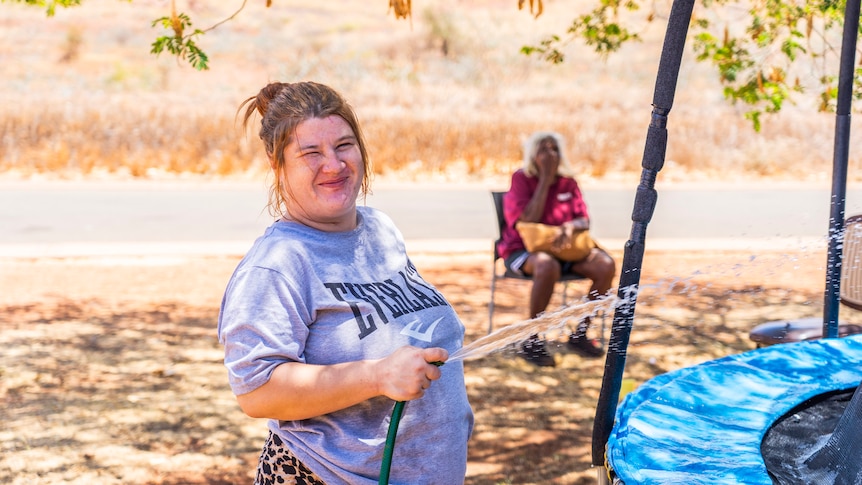
Jodie Forbs-Price and her neighbour Alice keep cool in the front yard. (ABC Pilbara: Kelsey Reid)
In the first week of summer, the Pilbara community of Roebourne has already endured a severe seven-day heatwave in which the mercury peaked at 46.8 degrees Celsius.
The town of about 1,000 is one of the oldest communities in Western Australia's north.
A number of the homes are public housing, and many of them do not have air conditioning.
For hours each day, Koori and Nyoongar mother Jodie Forbs-Price hoses down her four-year-old son Oliver on the trampoline in their front yard.
With no air conditioning in their state home, it is often cooler outside than in.
"I do love Roebourne, so that's why we do stay, but the heat does get too much," Ms Forbs-Price said.
"It's good country, just hot weather."
There are 680 public housing properties in the City of Karratha local government area.
As of October 31, the average waiting time for public housing in Roebourne was 117 weeks. Those on the priority list waited 57 weeks.
The Department of Communities said all housing built in the north-west after 1990 included ceiling fans, air conditioning apertures and insulation, but many homes in Roebourne pre-dated that.
The department said residents in older homes, such as Ms Forbs-Price, could purchase air conditioning at their own cost with approval.
Those living with a disability or medical condition could apply for air conditioning.
Ms Forbs-Price said she received $700 a fortnight from Centrelink after her rent and some bills were taken out.
The cost to buy and install an air conditioning system was out of financial reach for her and others in the community.
Ms Forbs-Price relies on a 20-centimetre box fan, ice-blocks, wet towels, and visits to the pool.
A spokesperson for the Department of Housing and Works said homes were built above minimum standards and made "thermally comfortable and sustainable in terms of costs for tenants to maintain".
The hot time
It is an issue Yindjibarndi elder Lyn Cheedy knows very well.
"You step out of your house, it's like somebody's there waiting to turn the blow-dryer on hot setting," she said.
Ms Cheedy recalled the measures she used to keep her children cool as they were growing up.
"One of the things I'd do, I'd get a sheet, wring it out, but still have a little bit of water in it, then I would cover my children over like that, and it was like an aircon for them," she said.
Ms Cheedy said Housing Minister John Carey would not handle a summer night in Roebourne without cooling.
"We might have to call an ambulance for him," she said.
"His reaction would be, 'Oh shit, this is what these people have to put up with year round."
A spokesperson for the minister said older houses were not the focus of the state government.
"The Department of Housing and Works' focus for new builds is to improve the comfort of tenants without adding to their ongoing costs," they said.
"As such, additions including high ceilings, ceiling fans, and improved insulation are provided.
"The minister regularly travels to regional WA and remote communities to meet with stakeholders, including Roebourne, earlier this year."
The bad luck time
Ngarluma Yindjibarndi Foundation chief executive Sean-Paul Stephens said it was well established in the community that there were more deaths over summer.
"It's sometimes the 'bad luck time', people will call it in English, and it's well known that those in the most vulnerable cohorts of children, elders — there is increased mortality at this time," he said.
A 2025 study from Monash Uni attributed 34 deaths in WA to heatwaves between 2016 and 2019, but that did not include deaths from other illnesses exacerbated by the heat.
With Roebourne patients often transferred to Karratha or Perth for treatment, death is recorded elsewhere, resulting in skewed data that does not reflect actual mortality in the region.
Mr Stephens said First Nations people in the region experienced cyclical disadvantage.
"It's almost impossible for a community to exit this entrenched disadvantage if you don't even have your basic needs met — you can't even live in a house that has climate control when it wasn't your choice to be in that house in the first place," he said.
Appropriate cooling has been an often talked about issue in the town, which has reached 50.5C previously, with the nearby Roebourne Regional Prison only fitted with air conditioning in July this year.
The facility was built in 1984.
ABC